
Softball Scorekeeping Guide
How to Keep Score in Softball
How to keep a fastpitch or slowpitch scorebook: the lineup with the DP and FLEX or ten fielders, what goes in each box, slaps and bunts, the tie-breaker runner, and the totals.
No credit card required. Free plan available.

How to keep score in softball, in short
Print one seven-inning sheet for each team, then for every plate appearance:
- Write the batting order with jersey numbers and position numbers. In fastpitch, list the FLEX below the ninth batter; in slowpitch, write 10 for the short fielder and EH for extra hitters.
- Mark the count in the box: balls in the three bottom squares, strikes in the two top ones.
- If the batter reaches, circle the hit (1B to HR) or write BB, HP, E or FC, and trace each base she reaches. Shade the diamond when she scores.
- If she is out, write the play with the fielders' numbers (K, 6-3, F8, SAC 5-3) and circle the out number.
- After the third out, rule a line under the box. After the game, total AB, R, H, BB and RBI and check the two sides balance.
Just need a blank one? Get the free printable softball score sheet
Softball is scored like baseball, with three differences
If you can keep a baseball book, you can keep a softball one: the same position numbers, the same diamond in every box and the same shorthand for every out. What changes is the game around it. A game is usually seven innings, fastpitch lineups can carry a designated player and a FLEX, and slowpitch puts a tenth fielder on the field and often bats more than ten. This guide covers the whole sheet, with those three in their place.
You need a pencil and one sheet for each team. The free printable softball score sheet has seven innings, ten hitters with a SUB line under each, and a second page that explains every symbol. If your games run long, the free score sheet generator prints up to ten innings.
The lineup
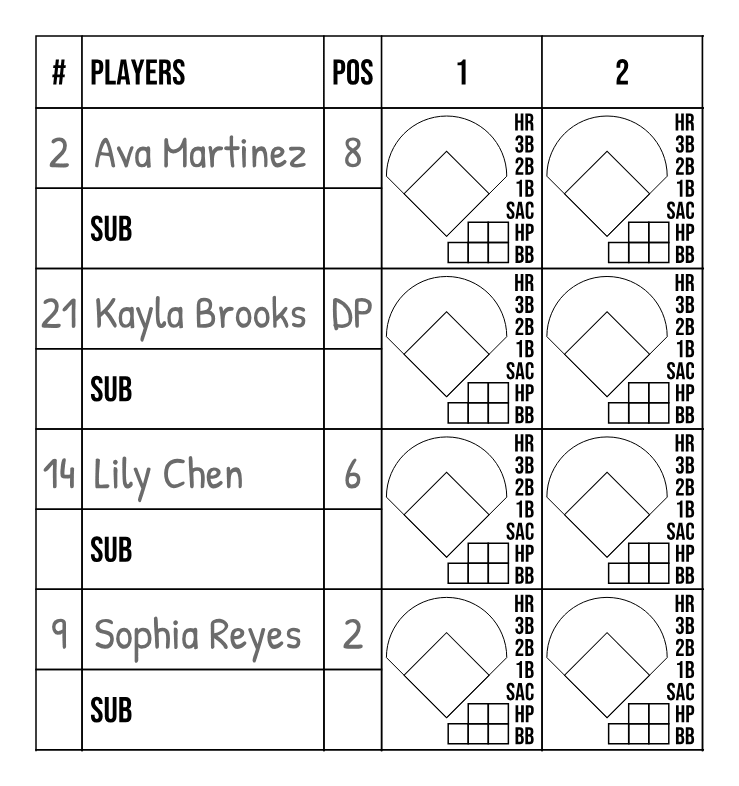
Write the batting order down the left: jersey number in #, the player's name, and her position number in POS.
- 1 pitcher, 2 catcher, 3 first base, 4 second base, 5 third base, 6 shortstop
- 7 left field, 8 center field, 9 right field
- DP a designated player in fastpitch, 10 the short fielder in slowpitch, EH an extra hitter
The numbers are the ones you will write in every play, so a ground ball to short thrown to first is 6-3 in softball too. The position numbers page explains why shortstop is 6.
Fastpitch: the DP and the FLEX
The DP bats in the order like anyone else, and she may also play the field. The FLEX plays defense for her and doesn't bat, so write the FLEX on a line of her own below the ninth batter, with her position. When the FLEX does bat, it is in the DP's spot: write her on that spot's SUB line and draw a heavy line across the grid where she came in. The DP and the FLEX are never in the batting order at the same time, so the book never has both of them hitting.
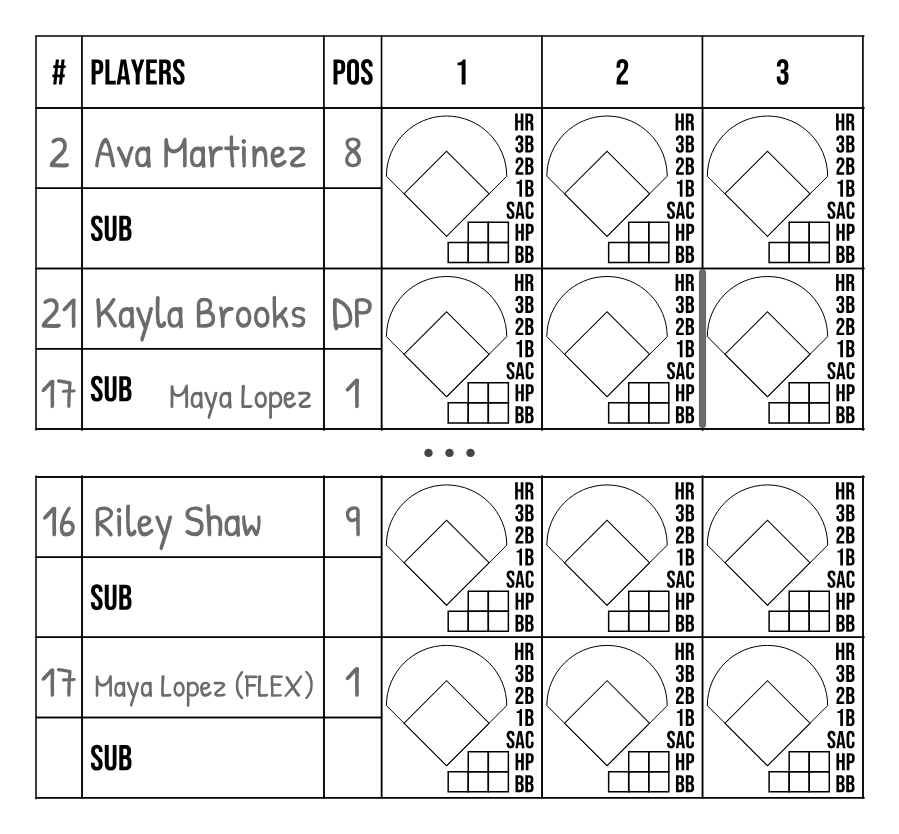
Leagues have their own rules for when each one may come out and go back in. The book only has to show who batted where; your league's rulebook says what is allowed.
Slowpitch: ten fielders and extra hitters
Slowpitch fields ten, so the lineup has ten rows before anyone extra. Write 10 for the short fielder, wherever your league plays her, and EH in POS for each extra hitter who bats but doesn't field. If your lineup bats twelve or fourteen, a sheet with more hitter rows saves squeezing names onto SUB lines; a free account prints as many as the page holds.
Inside each box
Every plate appearance gets one box: the batter's row, the inning's column.
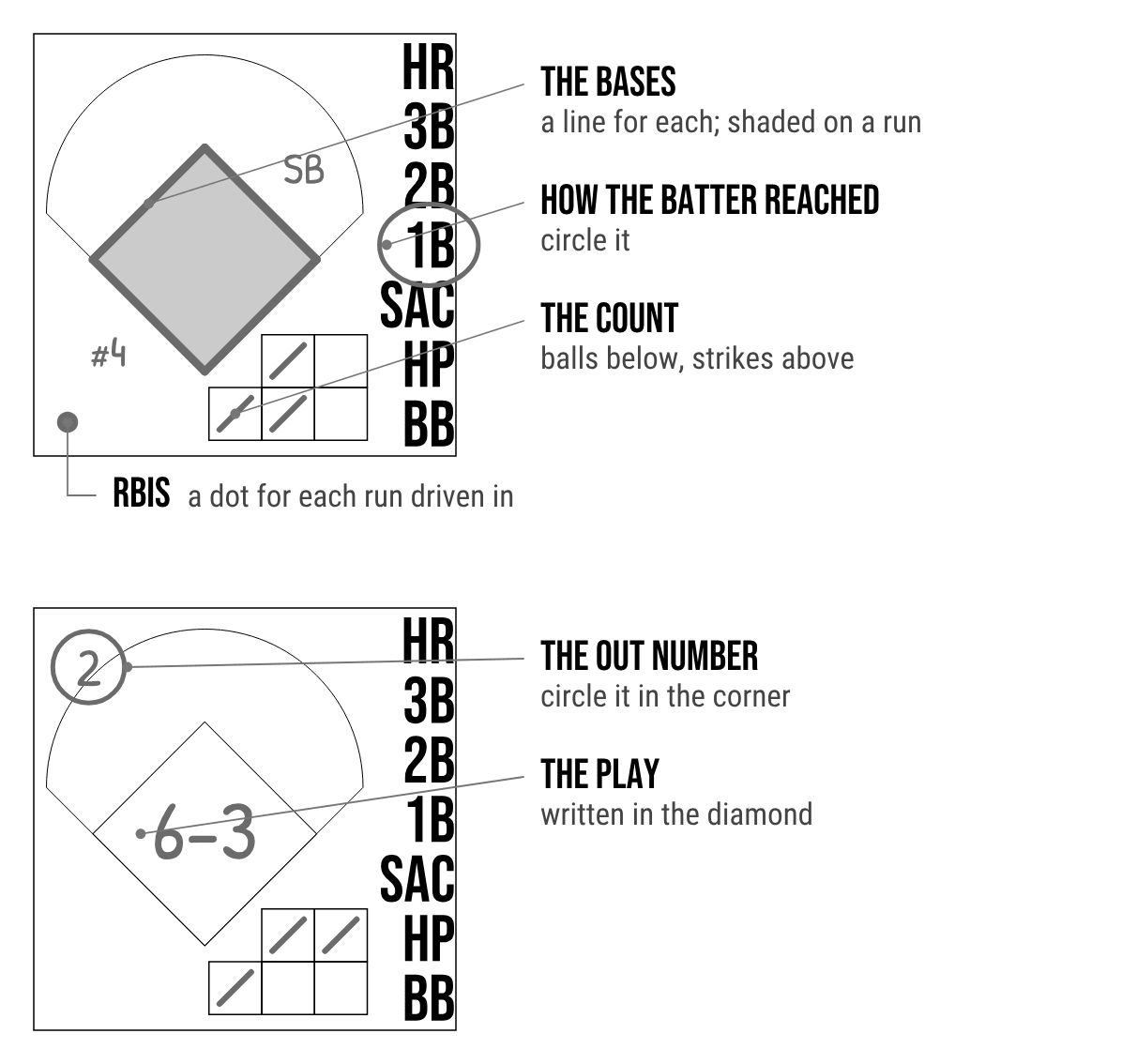
- The count. Balls go in the three bottom squares, strikes in the two top ones. In slowpitch, where many leagues start every batter with a count already on, mark the count you started from so the pitch total still adds up.
- How she reached. Circle 1B, 2B, 3B or HR for a hit, or BB for a walk. HP is a hit by pitch, E6 an error by the shortstop, FC a fielder's choice.
- The bases. Draw a line for each base she reaches, with what moved her beside it, and shade the diamond when she scores.
- The out. Write the play in the middle (K, 6-3, F8) and circle the out number.
- RBIs. A dot in the lower-left corner for each run her plate appearance drove in.
The plays softball adds
Most outs are written exactly as in baseball: K swinging, a backwards K looking, 6-3 ground out, F8 fly out, L6 line out, P4 pop-up, DP 6-4-3 a double play. A few plays come up far more often in softball, and each has a way to write it:
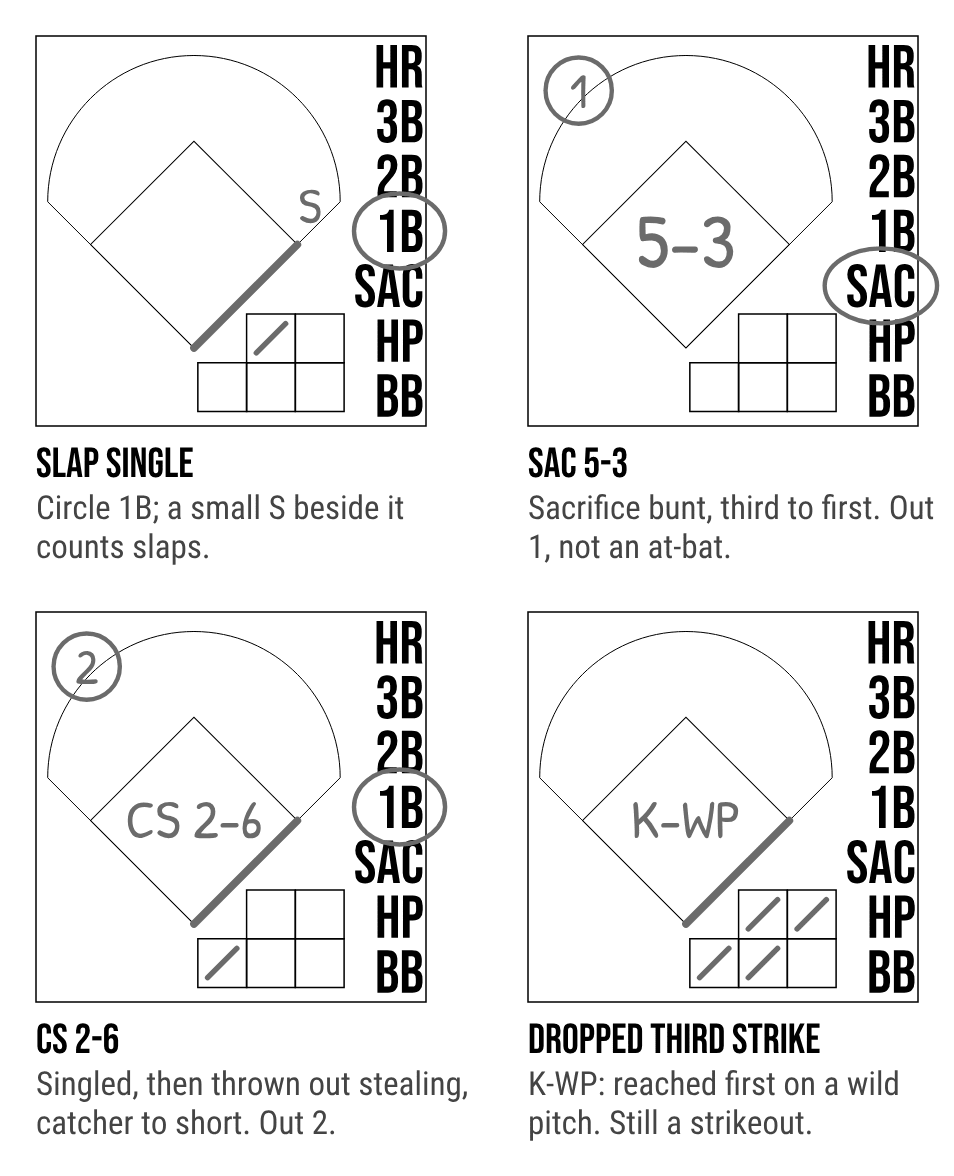
- The slap. A slap bunt that beats the throw is a single: circle 1B. Some scorers add a small S beside it so the coach can see how many hits came off the slap.
- The sacrifice bunt. SAC with the fielders, such as SAC 5-3 for a bunt the third baseman threw to first. It isn't an at-bat.
- The steal. Fastpitch runners steal often; write SB beside the base, and CS 2-6 when the catcher throws her out at second. Where your league doesn't allow leading off or stealing, those symbols simply never appear.
- The dropped third strike. When strike three gets by the catcher and the batter reaches first, write K and then how she reached (K-WP or K-PB). The pitcher still gets the strikeout.
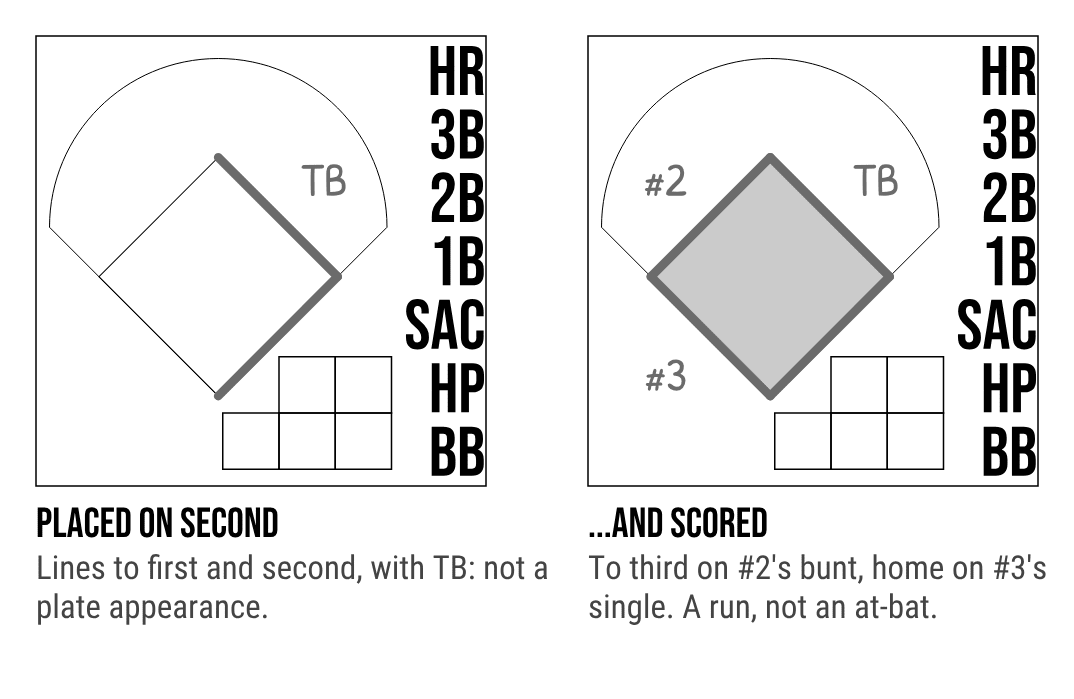
Extra innings and the tie-breaker runner
Many leagues start each extra inning with a runner already on second. Who that runner is, and when the tie-breaker starts, is your league's rule, so check its rulebook.
In the book, put her on second in her own row for that inning: draw lines to first and second and write "placed" (or TB, for tie-breaker) beside them. She didn't come to the plate, so it isn't a plate appearance, an at-bat or a time on base. If she scores, the run counts for the team and for her R total, and whether it is earned follows your league's scoring rules. Score the seventh inning's last batter and the eighth inning's leadoff batter as usual, and keep going.
A half-inning in fastpitch
- Batter 1: slaps a single past third, steals second. Write: Circle 1B; SB beside second.
- Batter 2 (DP): sacrifice bunt, pitcher to first; the runner goes to third. Write: Circle SAC, 1-3 in the diamond, circle out 1; #2 beside third in batter 1's box.
- Batter 3: singles to center; the run scores. Write: Circle 1B; #3 beside home in batter 1's box and shade it; one RBI dot.
- Batter 4: strikes out looking. Write: Backwards K, circle out 2.
- Batter 5: grounds out, second to first. Write: 4-3, circle out 3; rule a line under the box.
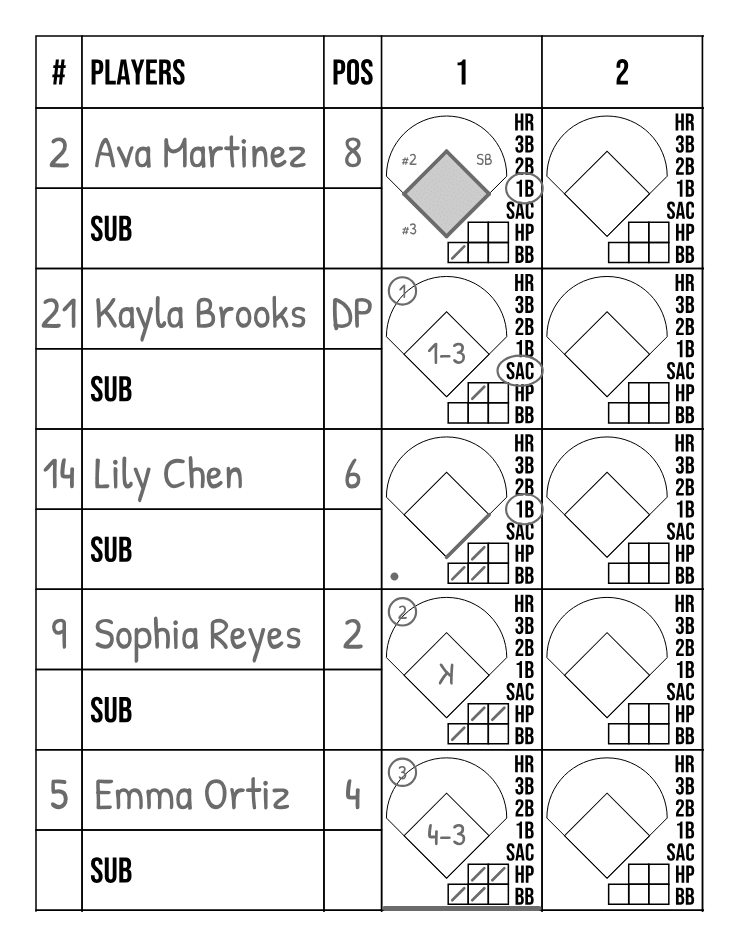
The inning's line at the bottom of the column: one run, two hits, no errors, one left on base. The SAC doesn't count as an at-bat for the DP.
After the game
Total each row: AB (every trip to the plate except walks, hit batters, sacrifices and catcher's interference), R, H, BB and RBI. Then check the team's numbers: at-bats plus walks, hit batters, sacrifices and catcher's interference should equal runs plus runners left on base plus the other team's putouts. With a FLEX or extra hitters in the lineup it is easy to put a plate appearance on the wrong line, and this is how you catch it.
From there, the batting average and on-base percentage calculators work the same for softball, and the ERA calculator figures ERA over a seven-inning game when you pick 7. Keep the pitcher's line at the bottom of the sheet, and the pitch count as you go with the pitch count tracker.
Whose call is it?
Whether a batter got a hit or reached on an error, and whether a run was earned, is the scorer's judgment, not the umpire's. Most youth teams have a parent keeping the book, and the coach's book is the one that counts for the team's stats. If your league has its own scoring rules or an official scorer, follow them, and check your league's rulebook for the DP, FLEX, extra hitter and tie-breaker rules, which vary from league to league and year to year.
Softball score sheets with your team on them
Seven innings or more, as many hitters as your lineup bats, your roster and team colors, and the fastpitch or slowpitch key on the sheet, from one free account.


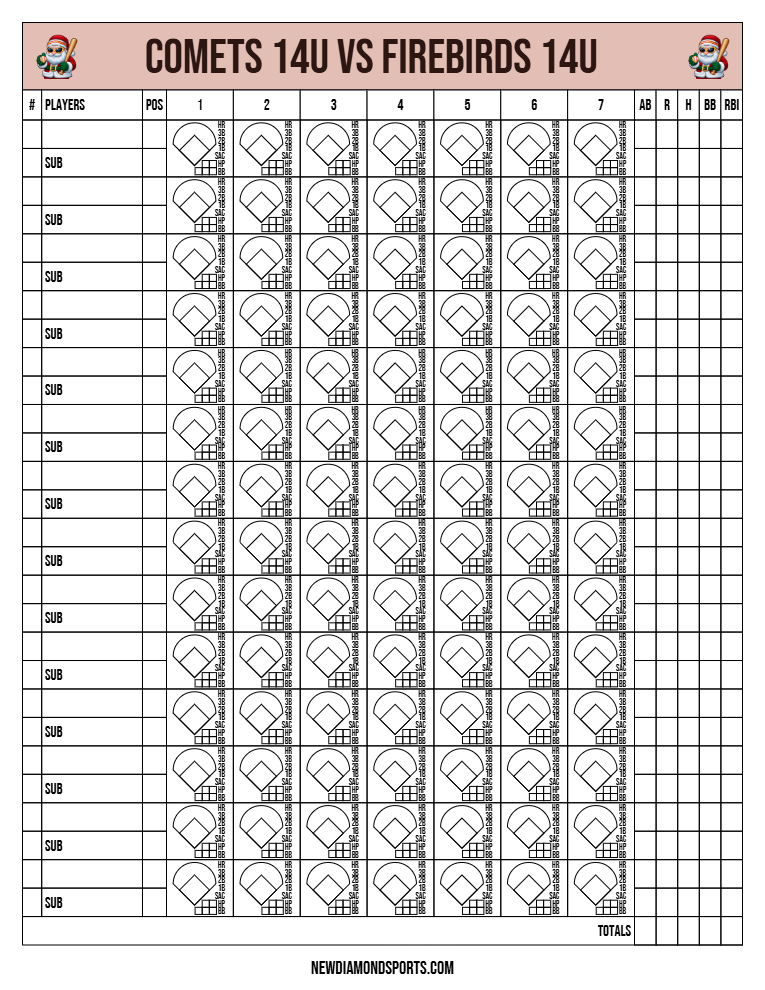


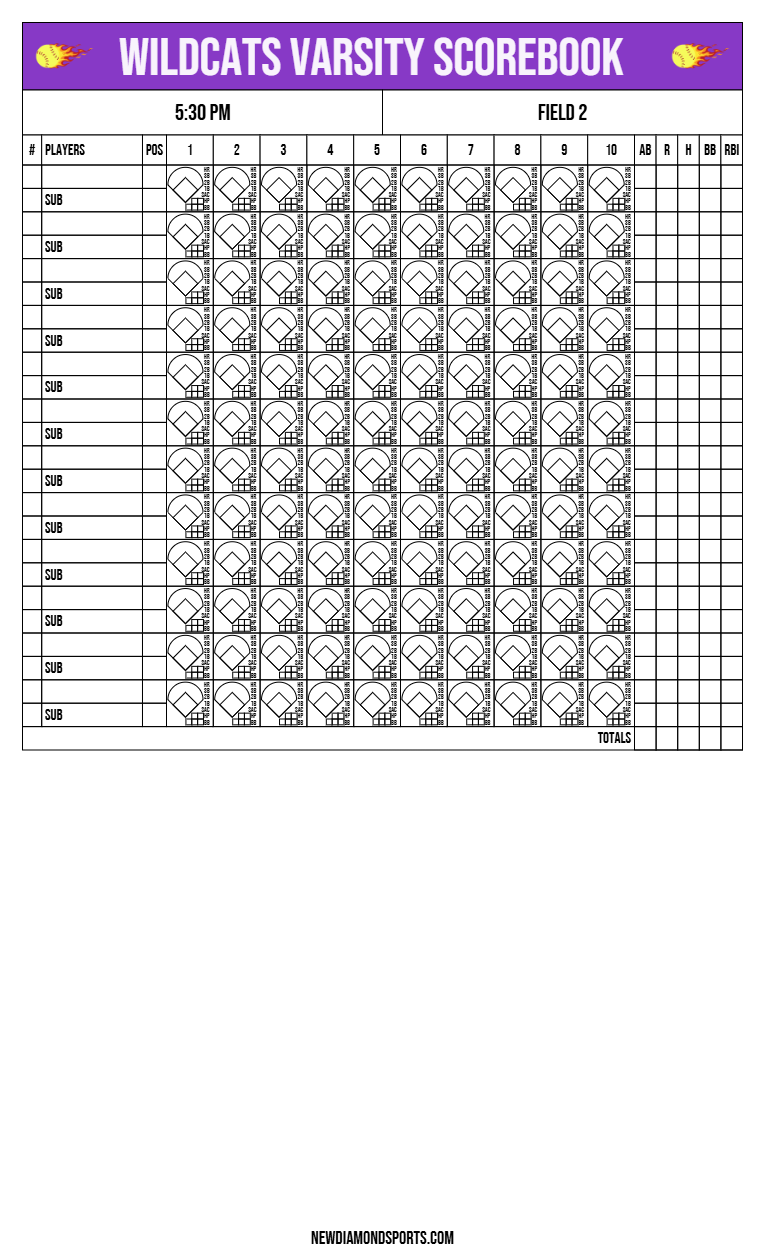

Full play-by-play scoring. Record every at-bat in traditional scorekeeping notation
Game summary totals. Roll up the box score automatically from the sheet
Archive-quality format. Produce a record worth keeping in the team scorebook
Fully customizable. Add your team colors or your team's logo.
4 ready-made templates included
- Basic Score Sheet (9 innings/9 hitters)
- Basic Score Sheet (9 innings/15 hitters)
- Score Sheet with Scoring Key
- Score Sheet with Second Page "How to Score Sheet"
No credit card required. Free plan available.
Frequently Asked Questions
Is keeping score in softball the same as in baseball?
Almost. The position numbers, the diamonds and the shorthand are the same. A softball sheet usually has seven innings, fastpitch adds the DP and FLEX, and slowpitch adds a tenth fielder (the short fielder, 10) and extra hitters (EH).
Where does the FLEX go on the score sheet?
On a line of her own below the ninth batter, with her position. She doesn't bat unless she takes the DP's place in the order; when she does, write her on the DP's SUB line and draw a heavy line on the grid where she came in.
How do I score a slap hit?
As a single: circle 1B. If the slap is fielded and thrown to first in time, it is a ground out, written with the fielders (5-3, 6-3). Some scorers add an S beside the hit to count slaps.
How do I score the runner placed on second in extra innings?
Draw her on second in her own box for that inning and write "placed" or TB beside the lines. She didn't come to the plate, so it is not an at-bat or a hit. Your league's rulebook says who the runner is and when the tie-breaker starts.
What does EH mean on a softball lineup?
Extra hitter: a player who bats but doesn't play the field. Write EH in the POS column. How many a team may use, if any, is up to your league.
Is there a softball score sheet with the key on it?
Yes. The free softball score sheet PDF has the fastpitch key under the grid and a full "How to keep score" page after it, and the free score sheet generator prints the slowpitch key instead.
More documents to go with your score sheets
Wristband Signs
Offense, defense and pitch-calling sign cards your players can’t miss.
Fully customizable. You determine the number of grids and their dimensions.
Cut-to-fit dimensions. Customize the height and width to fit your team's wristbands.
Personalize. Print your players' names/numbers on their card.
Mobile-friendly. Our software is designed to work on phones, tablets and desktops.
- Blank
- 12U/14U Offense
- 12U/14U Pitching Baseball
- 12U/14U Pitching Softball
- 16U/18U Offense
- 16U/18U Pitching Baseball
- 16U/18U Pitching Softball
- College Offense
- College Pitching Baseball
- College Pitching Softball
- Standard Defense


Lineup Cards
Create professional batting order lineup cards for exchange with umpires and opposing coaches. Clean, regulation-ready format with room for substitutes.
Regulation-ready format. Using DP/Flex? DH? EH? Two players in one slot? We got you covered.
Easy drag-and-drop interface. Drag and drop to build and rearrange your lineup (desktop only).
Fully customizable. Add your logo and team colors. Print your roster on the card.
Flexible. Print up to four cards on a single sheet of paper. Set between 7 to 12 starters.
- Blank Lineup Card (2 per sheet)
- Blank Lineup Card (3 per sheet)
- Lineup Card with Roster (2 per sheet)
- Lineup Card with Roster (3 per sheet)


Pitching Charts
Track pitch sequences, hitter outcomes, and fielded-ball locations on a printable chart designed for in-game pitching notes.
Pitch-by-pitch tracking. Log each pitch as the at-bat unfolds
Hitter outcome boxes. Record how each at-bat ended without breaking your flow
Pitch location reference. Mark where the ball was hit or where the pitch landed
Game note workspace. Capture extra scouting notes right on the same chart
- Standard Pitching Chart
- Pitching Chart with Notes Section


Start free. Upgrade when your season needs it.
The free plan includes one team and one of each document type, with no license fee and no credit card. Paid plans start at $2.50 a month billed annually, cancel anytime.
No credit card required. Free plan available.